
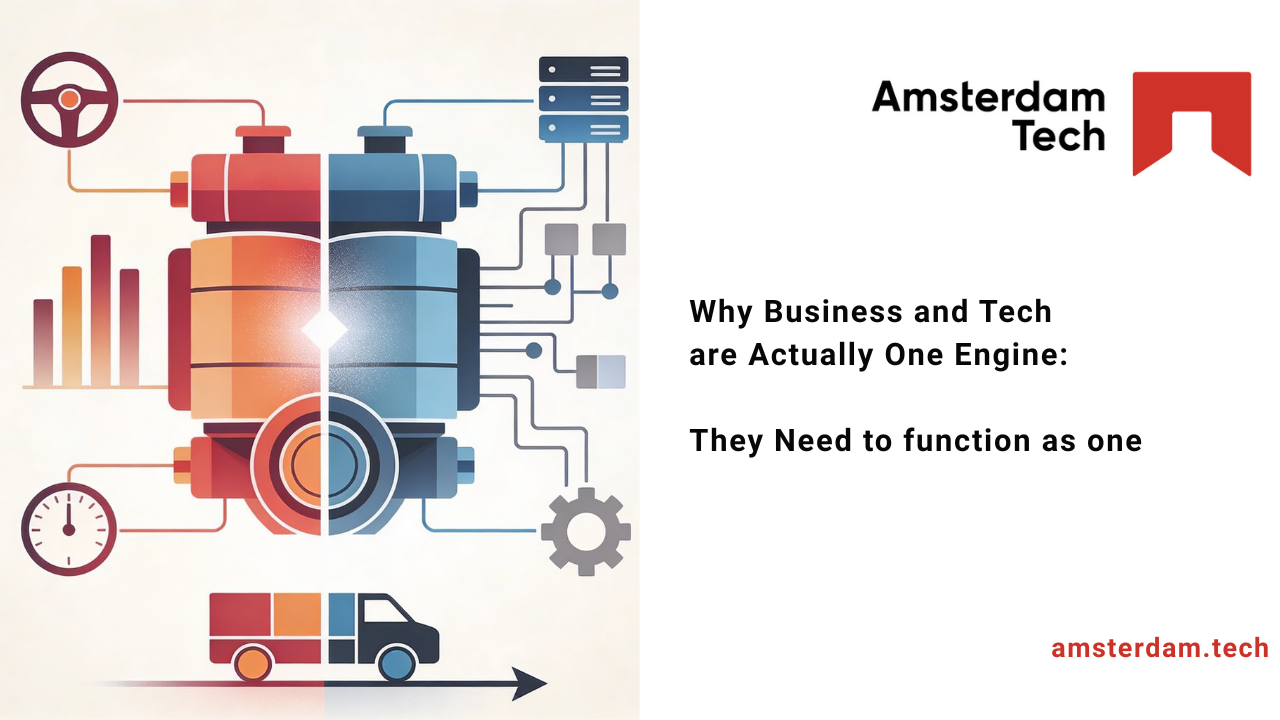
Why Business and Tech are Actually One Engine – They Need to function as one
For decades, corporate culture has been defined by a Great Divide. On one side of the glass, you have the “Business”—the suits, the strategists, and the bottom-line watchers. On the other side, you have “Tech”—the engineers, the data scientists, and the builders. We’ve treated them like two different species that occasionally meet at a neutral watering hole to exchange requirements and complaints.
But if you look at the most successful companies of the last decade, you’ll notice that this wall doesn’t just have cracks in it; it’s been completely demolished.
The Integrated Engine Philosophy
Mark’s career in Data Science & AI hasn’t just been about building better models or cleaner pipelines. It has been driven by a singular, career-long philosophy: Business and technology are not two separate entities—they are one integrated engine.
Think of a modern enterprise like a high-performance vehicle. You wouldn’t say the engine is “tech” and the steering wheel is “business.” Without the engine, the car goes nowhere; without the steering wheel, the engine just burns fuel in a vacuum. In the world of AI, a model that boasts 99% accuracy but doesn’t solve a specific customer pain point is just an expensive science project. Conversely, a business strategy that doesn’t leverage data-driven insights is essentially just a series of educated guesses.
Bridging the Gap with Applied Technology
This is where Applied Technology (AT) comes into play. AT isn’t just a department; it’s a mindset. It positions itself as the vital bridge between technical execution and strategic business impact.
Many organizations struggle with “The Last Mile” of AI. They have the talent and the data, but they can’t seem to translate that technical potential into measurable ROI. Mark’s approach centers on ensuring that every line of code and every algorithmic shift is anchored in a business objective.
- Technical Execution: This is the How . It’s the rigor of data science, the scalability of cloud architecture, and the precision of machine learning.
- Strategic Impact: This is the Why . It’s the market share gained, the churn reduced, and the operational efficiency unlocked.
When these two are synced, technology stops being a “cost center” and starts being a value creator.
The Future is Synthetic
As we move deeper into the era of Generative AI and automated decisioning, the integration of these two worlds will only tighten. We are entering an age where the “technical” person must understand the P&L, and the “business” person must understand the limitations and ethics of the algorithms they deploy.
By treating business and tech as a single engine, we don’t just build faster products; we build smarter companies. The bridge is built. It’s time to cross it.