
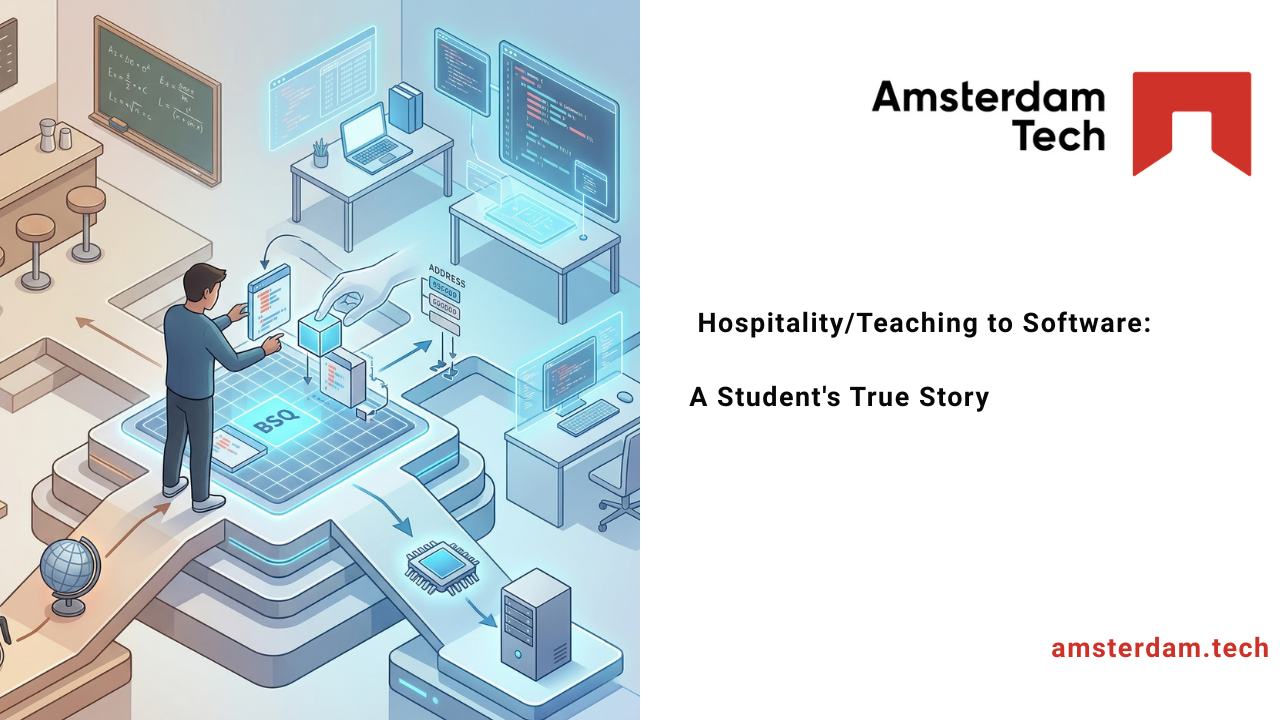
A Student’s Story From Hospitality/Teaching to Software – A Student’s True Story
If you have spent years in hospitality, teaching, or any other “people” job, switching to software can feel like jumping to another planet. That is exactly how it felt for Sam Davies when he started the Software Engineering path at Amsterdam Tech. Nearly a year in, that jump is starting to look much more like a smart, deliberate move.
His journey shows that you do not need a traditional tech background to become a serious developer. You need curiosity, persistence, and the right kind of learning environment.
When code feels like a new language
When Sam enrolled, the learning curve felt huge. He describes those first weeks as “impossible,” like learning a completely new language while using problem solving muscles he had never used before.
Over time, something shifted. The projects grew more complex, and the feedback became stricter. Instead of feeling crushed by that, he started to enjoy it. The reviews now focus on writing code to professional, industry standards. Things like consistency, structure, and style are not “nice to have” any more. They are expected.
It can be frustrating to be “hammered” on small details, but Sam sees how much it has raised his game.
Why someone from hospitality and teaching chose code
Before Amsterdam Tech, Sam’s work life looked very different. He spent his time helping guests, managing busy spaces, and teaching. Tech was something he heard about from a friend who worked in coding.
Every time they talked, it sounded more interesting. To test his interest, Sam tried FreeCodeCamp. The material felt stimulating and satisfying. That was his first signal that this was not just a passing curiosity.
Living in Italy, he needed:
- A course in English.
- Enough flexibility to keep a full time job.
- A path that was more structured than self study, but more flexible than a traditional campus.
A simple search led him to Amsterdam Tech, and he decided to give it a real chance.
Learning by doing, not just listening
Sam arrived expecting the classic university model: lectures first, projects later. Instead, he got something very different. He was given a project and told, in essence, “Go figure it out.”
At first, this was a shock. There was no constant tutor intervention. When something broke, he had to:
- Read the error messages himself.
- Search for answers.
- Try, fail, refactor, and try again.
Over time, he began to see the value. Each failure forced him to build real problem solving skills, not just repeat what a teacher said. Every refactor made his code more robust and his thinking more careful.
Now, when a project does not meet specifications on the first try, he treats that as the start of the real learning, not the end.
The BSQ project: turning theory into practice
One project that stands out for Sam is called BSQ (Biggest Square). On the surface, it is a puzzle: given a map in a file, find the largest empty square. In practice, it is a serious engineering exercise.
To build it, Sam had to:
- Read and process data from a file.
- Use a dynamic algorithm to stay efficient in both speed and memory.
- Keep his C code clean, modular, and readable, even as the logic grew more complex.
He also deepened his understanding of pointers in C. A pointer is a variable that holds a memory address. It lets you pass data to functions in a way that is efficient and flexible. The syntax can be confusing at first, but now Sam uses pointers to keep his program clean and organised.
The biggest shift for him was confidence. He now writes code with more structure and intention, instead of just trying to make it “work somehow.”
How Amsterdam Tech supports career changers like Sam
Sam’s story is a good example of what Amsterdam Tech is built for. The programmes are designed so people from hospitality, teaching, and many other fields can step into tech in a realistic way.
At Amsterdam Tech you get:
- Flexible, online and part time study, so you can keep your job and your life while you retrain.
- Project based learning, where each module leads to a real project, not just a test.
- Clear learning paths, so you know what to focus on next instead of getting lost in random tutorials.
- A supportive, global community, where people with very different backgrounds are all learning to become builders.
You are not expected to arrive as a “natural” programmer. You are expected to grow through deliberate practice and feedback.
What Sam’s journey means for you
If you are in a non tech job and wondering if software is “for people like you,” Sam’s path offers a few simple lessons.
- Your past experience is not wasted. Hospitality and teaching gave Sam communication skills, patience, and resilience, which help him handle tough projects now.
- A steep learning curve is normal. Feeling lost at the start does not mean you are not capable. It means you are learning something real.
- Projects and feedback are your friends. Every time a project comes back with corrections, you gain skills you can carry into the next one.
When you are ready, you do not have to leave your background behind to enter tech. Explore our programmes, see how Software Engineering or another path could work alongside your current life, and treat your first line of code as the opening scene of your next chapter, on your terms.