
Code of Conduct - Amsterdam Tech
Table of Contents
Part 1: Introduction
Amsterdam Tech Community Code of Conduct
At Amsterdam Tech, we are committed to creating an inclusive, respectful, and engaging learning environment for all members of our community—students, faculty, staff, and partners. This Code of Conduct outlines the shared expectations that guide our behavior and interactions. It reflects the values we uphold: responsibility, care, participation, collaboration, and integrity.
These principles are the foundation of our academic and professional community and support a climate in which every individual can thrive, contribute meaningfully, and feel safe to express themselves fully.
Purpose and Scope
This Code provides a common framework for conduct across all roles and settings at Amsterdam Tech . It exists to:
- Promote a respectful, safe, and supportive environment
- Uphold the ethical and professional standards of our institution
- Ensure consistent and fair responses to challenging situations
- Encourage reflection, open communication, and shared accountability
It applies to all members of the Amsterdam Tech community in both physical and digital environments, as well as during academic, professional, and social interactions connected to Amsterdam Tech .
Our Shared Values in Practice
- Accountability
We take responsibility for our actions and decisions, owning both successes and failures. We aim to set a clear example by holding ourselves and our colleagues to high standards and fostering a culture of trust and reliability. - Courage
We show courage by making tough decisions, even in uncertain or high-stakes situations. We support others in taking calculated risks and standing up for what they believe is right, regardless of potential backlash. - Care
We prioritize the well-being and growth of our colleagues. We listen actively, offer support, and create an environment where individuals feel valued and understood. - Collaboration
We encourage collaboration, valuing diverse perspectives and promoting open communication. We foster our sense of shared purpose and ensure that everyone’s strengths contribute to the group’s success. - Participation
We involve each other in decision-making, creating an inclusive environment where everyone feels empowered to contribute. We respect and integrate diverse inputs, fostering engagement and a shared sense of ownership.
Approach to Misconduct
We address breaches of this Code through a restorative and learning-oriented process. The goal is not punishment, but reflection, accountability, and repair.
Where conduct undermines our shared values or causes harm:
- We begin with open and respectful dialogue, aiming to understand and learn.
- Restorative steps may be taken to rebuild trust and repair impact.
- When appropriate, formal institutional procedures may apply, always with an emphasis on fairness, due process, and support for all involved.
Living the Code
This Code is not a static set of rules but a living expression of who we are as a learning community. We encourage all members to revisit and reflect on these principles regularly, to uphold them in everyday practice, and to engage others with openness and respect when challenges arise.
By aligning our actions with these values, we ensure that Amsterdam Tech remains a place of growth, inclusion, and mutual respect—for everyone.
Part 2: Policies and Procedures
The values outlined in Part 1 are reflected and operationalised through the academic and institutional policies that follow. Part 2 details the formal procedures that guide learning, assessment, participation, and support throughout the master programmes at Amsterdam Tech.
Application and Selection Policies and Procedures (TER, Article 2.3)
Teaching and Examination Regulations, Article 2.3 Application & Selection Process
- Programmes require an online application which asks for diploma(s), certification(s), and CVs.
- An intake interview conducted by the admissions officer is a part of the application process for the masters programmes. This interview serves to assess the candidate’s general motivation as well as their technical skills depending on the programme.
- The formal language of the programmes is English. English proficiency is required to be able to successfully complete the programmes.
- Students can join the cohort until the end of week 1 of the programme at the latest. Later applicants can apply for an exception. The content of a module “0” (consisting of online required study/reading material) can be individually assigned to late starters.
- Entry requirements for the programme can be found in appendix 1.
- During the academic year, there is one intake period for the programme which is November.
Assessment Submission and Resubmission Policies and Procedures
Teaching and Examination Regulations, Section 3: Assessment of Learning
Article 3.1 Types of Assessment
- In the Master programmes, assessment of learning is competency-based.
- Learner’s knowledge and skills are captured and measured through assignments, projects or presentations, which are then added to the learner’s portfolio as learning evidence.
- The mastery level is judged against the predefined competency standards in the form of evaluation rubrics. Further details on these rubrics can be found in the assignments on the learning management system.
- A faculty member (examiner) is responsible for evaluating the learner’s work and all results are announced on the learning management system before a learner moves on to the next module.
- As part of skills development of the learners, formative assessment is provided via written feedback on the learner’s work or in mentoring / supervision sessions.
- A mentor (in the technical modules) and a supervisor (in the final project phase) are available for learners who need academic or career-related advice and further support during the programme.
Article 3.2 Examinations
- Examiners, appointed by the examination board, are entitled to formative and summative assessment of a student’s work.
- In case a learner hands in the assignment after the deadline (only possible if a delay request has been granted), the examiner will have 10 calendar days after submission of the assignment to score it.
- Late submissions are only accepted if an extension has been requested and granted prior to the deadline. Students who fail to submit on time and do not request an extension will ‘automatically’ get a “0” on that assignment when the certification scores are calculated.
Article 3.2.1 Extension
- A learner may request an extension for a deadline to the examination board.
- A learner may request a deadline extension for assignment or final project submissions before the deadline. S/he fills out a form stating a reason and sends it to the Programme Manager, who makes the final decision within four days. Requests for extension after the deadline are not accepted.
- For the Final Project submissions, if learners cannot meet a given deadline (the minimum amount of study), a learner should request an extension for a maximum of six months by filling out an extension form and submit this to programme management. Extension requests should be submitted at least 2 weeks before the deadline expires. Failure to submit the Final Project Report or any required deliverables by the deadline without an approved extension or freeze request will result in an automatic “Fail” for that stage of the project.
Article 3.3 Determining and Announcements of Results
- Examiners are to determine and announce the results of an assessment within 10 working days after a candidate has submitted their assignment. If the examiner is not able to meet this evaluation deadline due to exceptional circumstances, they need to inform programme management right away so that an alternative examiner can be called into action.
- Learners are provided with feedback by the examiner on their assessed work pointing out the strengths and the improvement areas of the learner along with their score (feedback and feed forward).
- The final project is evaluated by two internal examiners and (if these two internal examiners cannot come to an agreement) one external examiner. Internal examiner 1 evaluates the final project mainly from the perspective of action research methodology while internal examiner 2 mainly evaluates it from the perspective of the other subject domain (e.g data science). In case the internal examiners cannot agree on a fail/pass decision, the external examiner is invited to evaluate the final project based on the evaluation criteria and give a final verdict. In case the internal examiners (and, if needed, the external examiner) deem the students work adequate, the student is invited for a final video presentation and q&a session on his/her work. After that, the scores of the internal (and, if necessary) external assessment culminate in the final score.
Article 3.4 Scoring Scale and Marks
- The learner receives a rubric score on a scale of 1 to 5 for each learning outcome that is associated with an assignment and an overall score out of 100. The scoring scheme can be found in the Learner Handbook. The learner’s score will be rounded to the nearest whole number.
- The expected mastery level is 3 for each learning outcome – the scores will be rounded up to tenths on the certification’s report cards.
- To pass a certificate, an overall score of 60 or higher is required.
- To pass the final project, an overall score of 60 or higher is required.
Article 3.5 Resubmissions, Failure and Second Chance in the Certifications
- Learners can re-submit work in order to increase their mastery level within 14 working days after the results have been announced. In the case of a resubmission, the second mastery score counts as 65% and the previous score as 35% of the total weight. E.g. if a learner scored 3 in the first one, and 5 in the second, then their final mastery score would be 4. Their final evaluation score (out of 100) will be the second score they receive.
- Learners cannot resubmit if they received a zero score because submissions were closed. Resubmission only applies after a submission of work has taken place.
- Learners can re-submit work only once.
- The timeliness of work submission is processed in a separate time management score. The rubric on time management is available on the learning management system.
- In case learners fail a certificate they can apply for a second chance. More information can be found in the failure and second chance policy and procedure documents.
- To apply for the second chance, the learners can use this form.
Article 3.6 Validity Period for Results
- Assessment results that count towards an Amsterdam Tech Professional Master’s degree remain valid for an unlimited amount of time, except in cases of temporary withdrawal exceeding five years, as per the Failure and Second Chance Policy.
Article 3.7 Discussing the Scoring Results
- After the results of any assignment have been announced, the learner can arrange a call with the examiner to discuss the results or to receive more feedback on his/her work if the written feedback has been found insufficient.
Article 3.8 The Right to Appeal Assessment Results
- For a period of at least 14 working days after notification of the results of any assignment, the learner has the right to inspect his/her graded work on request. Information on academic appeals is provided in the Learner Handbook.
- The Programme Management officially (in writing) gives permission for inspection upon receiving the learner’s written request.
Article 3.9 Inclusive Assessment and Examination Provisions
- The programme aims to provide an inclusive and accessible learning environment that ensures all students, regardless of personal circumstances, are given equal opportunities to demonstrate their knowledge, understanding, and skills.
- If a student is unable to comply with the standard examination or assessment criteria due to a disability, chronic illness, neurodiversity, or other special personal circumstances, the student may submit a request for reasonable adjustments to the Examination Board. Please see Appendix 3.
Article 3.10 Certificates and Diploma
- The Examination Board issues a certificate to a learner who completes a certification phase with a passing score of 60 in the programme.
- The Examination Board issues a diploma to a learner who has passed all the certifications, completed his/her final project successfully and has satisfied all the procedural requirements including the payment of tuition fees.
- The certificates and the diploma are provided in English.
- Diploma supplements are provided along with the diplomas. Principles and Guidelines for the diploma supplement can be found here.
- A learner may ask the Examination Board to delay the issuing of his/her certificate or diploma.
- The names of courses/modules listed on the grade list and diplomas must correspond to the official course/module names as specified in the Teaching and Examination Regulations (TER) that were active during the academic year in which the course/module was completed.
- If a course/module name changes after a student has completed it, the original name under which the course/module was completed will be retained on the grade list and diploma.
- Exceptions to this rule may only be made in cases where Programme Management determines that using the original name would cause significant confusion for external stakeholders, such as employers or accrediting bodies. In such cases, a footnote or explanatory remark will be included in the grade list or transcript.
- Students have the right to request clarification or documentation regarding the equivalency of module names, if needed for external purposes, such as recognition by other institutions or employers.
Article 3.11 Academic Integrity
- Plagiarism and academic misconduct are defined as any act by a student that partially or completely precludes an accurate assessment of their knowledge or skills or those of another student. Plagiarism can include handing in someone else’s work or copying work, long or short, from a source without providing a reference or acknowledgement. This also applies to AI tools that help learners generate responses on any work that is part of an assessment, where students fail to disclose the use of such tools, provide proper referencing and citation for content or insights generated by these tools and demonstrate reflective and critical thinking regarding the use and results of these tools. Faculty is also required to integrate such technology into their teaching with disclosure, accountability and reflection. Refer to the Policy on the Use of Advanced Technology in Teaching and Learning for further details.
- If the examiner has a good reason to suppose that plagiarism or academic misconduct has taken place, s/he must report it to the Programme Manager.
- The Programme Manager informs the learner and invites the learner to a hearing about the claimed plagiarism or the academic misconduct. The Examination Board makes a final decision based on the evidence. In the case of plagiarism the learner’s work is assigned 0.
- In case of a repeated misconduct or plagiarism, the Programme Management, after consulting the Examination Board, has the right to terminate the learner’s registration permanently.
- The learner can appeal to the decision within six weeks of the announcement of the decision. The Examination Board makes the final decision on the result of the appeal.
Article 3.12 Exemptions through Recognition of Prior Learning
- The Examination Board is authorised to grant exemptions to a learner through Recognition of Prior Learning (RPL) if a learner has demonstrated the achievement of prior learning that corresponds in sufficient measure to the module(s) which the learner wishes to be recognised. Learners must submit a substantiated request to the Examination Board indicating and documenting the evidence that the learner has achieved the learning outcomes in question. Based on the evidence submitted, the Examination Board will determine if the learner has met the requirements for the relevant module and inform the learner within four weeks from the date on which the request was received.
- At Amsterdam Tech, a formal RPL policy has been adopted, which is complemented with a tailor-made procedure for learners in the Professional Masters. This procedure can be found in the Learners’ Handbook.
Digital Accessibility Policies and Guidelines
Amsterdam Tech is dedicated to establishing a welcoming and equal digital learning experience to all learners with or without disabilities. This policy provides direction on creating an accessible learning environment that enhances usability for everyone.
Implementing this policy will ensure that all individuals have access to Digital Content, Resources, and Technology (“Digital Material”) provided by or on behalf of the institute.
The institute is still continuing to improve its accessibility standards.
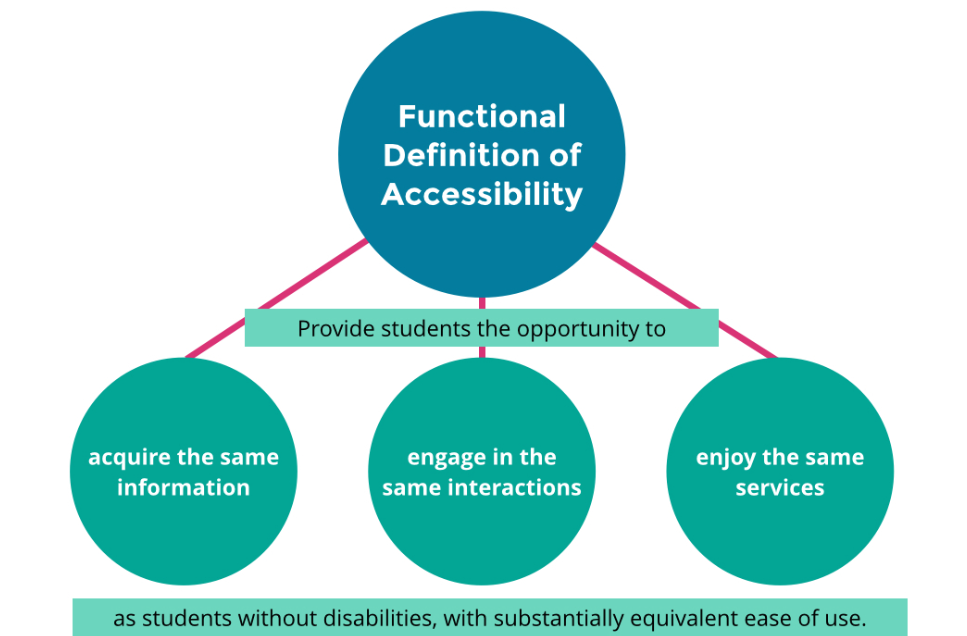
Students with disabilities must be provided the opportunity to—
- acquire the same information
- engage in the same interactions, and
- enjoy the same services as students without disabilities
- with “substantially equivalent ease of use.
The Scope of Digital Accessibility
All Amsterdam Tech programmes are provided digitally. This policy applies to all institute Constituents and third parties who make available Digital Material when conducting the programmes and all related activities within the programmes.
This policy must apply to all institute Digital Material regardless of audience or authentication required, including but not limited to:
- Websites
- Video and audio content
- Electronic documents
- Desktop, mobile, and cloud-based software applications
- Content management systems and learning management systems
- Interactive tools and platforms
- Email and calendars
- Live conferences
- Library resources
- Digital content and materials used in a course
Standard for Digital Accessibility
WCAG 2.0
The digital material provided by Amsterdam Tech must meet minimum accessibility requirements according to the guidelines laid out by Web Content Accessibility Guidelines (WCAG) 2.0 Level AA. According to these standards, learning materials at Amsterdam Tech must conform to the following:
Perceivable
Information and user interface components must be presentable to users in ways they can perceive.
- Provide text alternatives for any non-text content
- Make it easier for users to see and hear content including separating foreground from background
Operable
User interface components and navigation must be operable.
- Make all functionality available via a keyboard.
- Provide ways to help users navigate, find content, and determine where they are within content.
Understandable
Information and the operation of the user interface must be understandable.
- Make text content readable and understandable.
- Make web pages appear and operate in predictable ways.
Robust
Content is robust enough that it can be interpreted reliably by a wide variety of user agents, including assistive technologies.
- Maximize compatibility with current and future user agents, including assistive technologies.
Specific guidelines for each criteria can be found on the following guide:
Examination Board Policies and Procedures
1 – General provisions
Article 1.1 – Applicability of the Rules and Guidelines
These Rules and Guidelines shall apply to the exams and final examinations of the professional master programme(s), hereinafter referred to as: the study programme
Article 1.2 – General
- The terms defined in the Teaching and Examinations Regulations (TER) for the relevant programme shall also apply to these Rules and Guidelines. The remaining terms shall have the meanings ascribed to them by the Act.
- In the event that a provision in these Rules and Guidelines is in conflict with a provision in the TER for the relevant programme, the latter shall prevail.
Article 2.1 – Composition of the Examination Board and Decision Making
The Examination Board consists of at least three people of which one chairperson, 1 internal faculty member and an official secretary. Additional members can be appointed based upon a specific profile, related to the program or external expertise, in order to strengthen the board’s independent position. The official secretary is responsible for handling the day-to-day affairs of the Examination Board. The members of the Examination Board, including the official secretary, are appointed by the institution’s presidency for 2 years to fulfil their duty as a member. The board can select out of its members a vice-chairperson and assign certain responsibilities to its members. Decisions are made by the examination board, based on an equal ruling of the votes. In case of a tied vote, the chairperson decides. The official secretary is excluded from voting.
Article 2.2 – Duties of the Examination Board
The Examination Board is a body at Amsterdam Tech which guarantees the quality of the examinations and exit qualifications. The duties of the Examination Board are set out by law.
To this end, the Examination Board is responsible for the following duties and responsibilities:
- Ensuring that criteria and requirements set out in the Teaching and Examination Regulations are met regarding the intended learning outcomes and profile of a graduate
- Advising on the Teaching and Examination Regulations where necessary
- Safeguarding the quality of examinations in accordance with the programme’s target competencies
- Establishing the standards and guidelines for scoring and awarding results for examinations within the framework of the Teaching and Examination Regulations
- Granting exemptions from taking certain modules or projects
- Taking measures against plagiarism and making the final decision in case of plagiarism
- Appointing examiners to conduct assessments and determine their results
- Issuing certificates and diplomas
- Granting a learner permission to follow a flexible curriculum, the final examination for which will lead to the obtaining of a degree
- Publishing an annual report on its activities
Article 2.3 – General benchmarks
The Examination Board monitors the quality of the degree programme and that students’ learning outcomes are being achieved. The Examination Board uses a number of general benchmarks in its decisions. These are:
– the need for students to achieve the learning outcomes of the relevant programme in order to graduate;
– the desirability that only students that meet the entry requirements will move on to the next phase of the programme;
– the desirability of limiting time wasting for students as much as possible in preparing for examinations;
– the desirability of encouraging students to discontinue their degree programme as early as possible, if passing a certificate or final examination (final project) has become unlikely;
– the desirability of protecting students from themselves in cases when they wish to take on too heavy a study load;
– strictness with regard to students who deliberately or repeatedly violate rules.
Article 2.4 – Decision period of the Examination Board
The Examination Board shall take a decision no later than eight weeks after receiving a written petition.
Article 2.5 – Meetings of the Examination Board
The Examination Board shall meet at least two times a year.
3 – Examiners
- There is at least one examiner for every programme curriculum.
- The examiners are responsible for measuring the learning mastery, giving constructive feedback to student work (assignments, projects etc.) and determining the final results for each module and the programme.
- The Examination Board identifies the requirements for examiners and appoints them to programmes.
- The Examination Board can appoint professionals outside the institute as external examiners.
- The examiners shall agree to provide the Examination Board with the required information.
4 – Measurement of Learning Mastery
Article 4.1 – Requirements
The requirements to be fulfilled for the successful completion of a programme or a module are explained in the Programme Handbooks. The examiner is responsible for measuring the students’ learning mastery on the relevant components of the programme. Measurement may consist of assignments, projects, presentations, essays, reflective accounts or other practical / hands-on forms of testing that are relevant for evidence-based learning and assessment in each programme. The content of the assessment needs to be based on the learning outcomes of the modules and the programme.
Article 4.2 – Participation and Learning as Responsibility
Specific rules or expectations are outlined in the handbooks for each programme. Students who are enrolled in each degree programme are expected to participate in learning activities as an accountable community member.
Article 4.3 – Deadlines
Specific deadlines such as assignments and projects are communicated via handbooks and the learning management system.
Article 4.4 – Assessment
- Assessment in the programmes is project-based. Students are entitled to project submission if they are properly registered to the programme in time, meet the entry requirements and are registered in the institute’s learning management system.
- No scores will be given to any study units for which the student has no valid enrolment.
- The workload for a single module project shall take no longer than 16 hours to complete.
- All submissions shall be made online by the student in the relevant course on the learning management system.
- Student work is assessed based on predetermined rubrics, which are set down in writing on the learning management system and which may be modified based on the correction process. In this case, the student is informed timely.
- The method of assessment shall be in a manner that the student is able to verify how the results of his or her assessment have been arrived at.
- Final scores for each certification shall be assigned on a 100-points scale based on the predetermined weights of the assessed items. The information on weights shall be available in programme handbooks and on the learning management system.
- If relevant, the examiners might apply the moderated assessment method to determine the final score of the student work.
- The passing score of a course (certificate) must be at least 60.
- Rules regarding plagiarism are outlined in the programme handbooks. By participating in the assessment, the student gives their consent for the work to be run through the plagiarism-scanning software where relevant.
Article 4.5 – Assessing the learning mastery of the programme learning outcomes
- The learning mastery shall be assessed by the examiners in the programmes. The rubric evaluation (1-5) is used to show the learners where they are in their learning mastery, and they can resubmit the assessed work if they wish to increase their learning mastery in a specific competency.
- The satisfactory score for each learning outcome is 3 out of 5.
- All rubrics and evaluation criteria shall be made available in the programme handbooks and in the learning management system of the programme.
Article 4.6 – Resubmissions to increase learning mastery
- Students can re-submit assignments and module projects in order to increase their mastery level in the learning outcomes within 14 working days after the results have been announced. In the case of a resubmission, the second mastery score counts as 65% and the previous score as 35% of the total weight. E.g They scored 3 in the first one, and 5 in the second. Then their final mastery score would be 4.
- Their final score out of 100 will be the second score they receive.
- Learners cannot resubmit after their score has been scored zero when the submissions are closed. Resubmission only applies after a submission of work has taken place.
- Learners can re-submit work once.
- When a learner submits work late, reduction in the time management score is applied. The rubric for the time management is made available on the learning management system.
Article 4.7 – Work-based Final Projects
- All students who are entitled to take the Final Project module are required to submit a final project whose requirements are outlined separately in the programme’s handbook.
- Final projects are required to go through both internal and external examinations.
Article 4.8 – Oral Assessments (Viva Sessions)
- All students are required to participate in a Viva session in which they voice their learning after a certification and as part of their final project assessments.
- An internal and external examiner shall be appointed to take part in the Viva of the final projects.
- An Examination Board member may also be invited to join a Viva session.
- Viva sessions shall be conducted at times to be determined by the examiners if possible following consultation with the student.
- Students are informed at least two weeks before the session about the expectations and the session’s details.
- Students must receive their learning mastery reports before they arrive in the Viva session.
Article 4.9 – Fraud and plagiarism
- The provisions of the regulations governing fraud and plagiarism for the students apply in full, and form part of these rules and guidelines.
- If an examiner discovers that a student has plagiarised (e.g copying from another student), the examiner shall make a written report to be presented to the Examination Board within five working days.
- The Examination Board decides on any possible sanctions in the first meeting after the fraud or plagiarism was discovered and the student has been given the opportunity to respond to the allegation.
- The Examination Board may decide to deem invalid the assessment in question and to exclude the student from further participation in the assessment in question or from every assessment for a period of no more than one year.
5- Academic Appeals
- Any student who believes that an error or errors have been made in the assessment of his or her exam (assignments or projects) may submit a reasoned request in writing for a reassessment to the examiner no later than 14 days.
- Academic Appeal procedure shall be available to students in the Learner Handbook and at www.amsterdam.tech
6 – Awarding Degrees
If a student meets the requirements for graduation, the Examination Board will, in principle, automatically proceed to award the degree certificate, unless the student requests otherwise. The Examination Board may decide not to honour this request, but must have well-founded reasons for doing so.
If the weighted average of all compulsory (examination) components is 60 or higher and the final project has been awarded a minimum score of 60, the Examination Board shall consider awarding the degree qualification. The Examination Board has the option to deviate from these rules in special circumstances (either on request of a student or not). This means that a degree qualification is not automatically awarded. Other diploma classifications shall be listed on the diploma supplement.
7 – Recognition of Prior Learning (RPL)
An exemption from certain modules or final examination (final project) implies that the student is deemed to have passed the relevant module or final examination, without a score being awarded. Requests for exemption from an exam or final examination must be submitted to the Examination Board through the RPL process.
8 – Retention periods
Examination materials for which a score or partial score is awarded, as well as the results of exams, including final projects, degree certificates and diploma supplements, shall be retained for a period of five years.
9 – Hardship clause
The Examination Board may make exceptional arrangements in cases where the provisions of these Rules and Guidelines have unreasonable or unfair repercussions for the student.
10 – Amendments
These Rules and Guidelines shall not be amended during the current academic year, unless such amendments can be reasonably assumed not to damage students’ academic progress.
11 – Effective date
These Rules and Guidelines shall enter into effect on 1 April 2021 and apply until the new version of the Rules and Guidelines has been defined.
Failure and Second Chance Opportunities
1.1 Types of Failure
- An assessment is failed if:
- The work submitted for an individual assessment is not of a high enough standard to gain a pass mark (set at 60%);
- no work has been submitted by the end of the relevant module (taking into account any reasonable adjustments or approved changes to assessment arrangements), and no allowance has been made on the basis of exceptional circumstances.
- A certification is failed if:
- the work submitted for the modules is not of a high enough standard to gain an overall pass mark (set at 60%) for the certification, based on the weightings of individual modules;
- the student has breached the academic conduct regulations and a penalty of failing the certification has been imposed.
1.2 However, the institute is committed to providing appropriate opportunities for students who fail an assessment or a certification to retrieve their position, in line with the following conditions:
- A student who does not pass an assessment at the first attempt will have one opportunity to re-submit that assessment, within the appropriate period of two weeks after the grade is announced. The same right applies to students who have passed the assignment, but want a chance to improve on their original score;
- The mastery score in the learning outcomes at re-submission will be capped with the original grade counting for 35% of the total mark and the second score for 65% of the total mark, unless an allowance for exceptional circumstances has been approved;
- The final evaluation score (out of 100) will be the second score they receive.
- If re-submission fails to deliver a score of 60% or higher, this does not automatically lead to a failure on the relevant module. This requires an overall pass mark lower than 60% for the module, based on the weightings of other individual assessments in the module;
- A student is eligible to retake a failed certification twice, providing a reflective account with a rigorous action plan of how s/he expects to do differently and perform better at the next attempt has been submitted and accepted by faculty. (1) Upon acceptance of the application by the programme faculty, the student can enroll in the same certification with the next cohort at an additional cost covering tuition fees (unless an application for exceptional circumstances has been accepted on this). (2) If the application is not approved by the faculty, the student can appeal to the examination board. Once the examination board confirms the faculty’s negative advice, its decision will be final;
- Any marks (pass or fail) obtained during the first attempt at the certification in the student’s original cohort will be considered null and void, which means the student will have to submit all assessments and complete all modules as mentioned in the programme handbook valid for the following cohort;
- In case an application for exceptional circumstances has been accepted, a student is allowed to retake a certification;
- In case an application for temporary withdrawal has been accepted, a student is allowed to rejoin the programme in a cohort that is not necessarily the one timewise following his/her original cohort;
- Once a certification has been passed, a student is not permitted to re-take that certification.
1.3 The institute considers an exceptional circumstance to be:
- Personal circumstances that are out of the control of the student; and
- that the student could not reasonably have prevented or accommodated; and
- that must have had a significant and demonstratively negative effect on the student’s ability to study or undertake an assessment;
- Additionally, the timing of the circumstances must be relevant to the affected assessments and/or period of study.
All elements must be met in order to substantiate an application for exceptional circumstances.
1.4 The institute considers withdrawal to be:
- A student wishing to withdraw temporarily must have a written agreement to do so for a specific period of time and may also have to satisfy pre-agreed conditions before re-enrolling. Any student who withdraws without the appropriate permissions, or fails to re-enrol following the expiration of the specific period of time, may be considered to have permanently withdrawn;
- The maximum period for temporary withdrawal has been set at a maximum of five years. If this period has passed, and a learner wishes to re-enrol in the programme, this learner’s assessment scores and/or acquired certifications within his/her original participation in the programme become void. As a result, a learner who wishes to return to the programme after a period of five years has passed upon his/her original registration, and receives faculty permission to do so, will need to re-do the entire programme;
- A student who withdraws from their course permanently may be liable for ongoing tuition fees if they fail to notify the institute in a timely manner;
- A student who fails to maintain enrolment and registration requirements, and does not respond to communications from his/her supervisor and the institute for a period of one certification, will be withdrawn from their programme of study.
Failure and Second Chance Opportunity Procedure
How do you apply for an application for exceptional circumstances which can support an application to have a second chance opportunity at a certification?
- Contact your programme manager about your application. This needs to be done within four weeks of failure of a certification being communicated to you by the programme management. S/he will invite you for an advisory consultation. In this consultation, the programme manager and you analyse the personal circumstances that are cause for your application and discuss the possibilities for evidence you might present. In this consultation, the programme manager also explains how to fill out the application form and how to build a back-up file of documents (if needed). Finally, a deadline is set for the application to be submitted. If you do not meet this deadline, you automatically forgo on the opportunity to apply for exceptional circumstances.
- You complete the exceptional circumstances application form by the required deadline. This is normally within two weeks of having the advisory consultation with your programme manager. This form also includes a separate chapter in which to apply for a second chance on your certification and a chapter in which to apply for temporary withdrawal.
- Once you have completed the application form and back-up file of documents (if needed), you submit it to the Dean of the Professional Masters in Data Science and Leadership programme at Amsterdam Tech. S/he will evaluate and decide upon your application in consultation with the programme manager and the Head of the Examination Board. Within three weeks of your submission, you will receive a decision which is considered final and cannot be challenged or contested at a higher level.
Important!!! How much does the application cost?
Applying for exceptional circumstances in combination with an application
for a second chance on either modular or certification level
and/or an application for temporary withdrawal
comes at a cost of 100 EUR to be paid at submission of the application form.
Freezing of Registration Policies and Procedures (TER, Article 2.7)
Teaching and Examination Regulations, Article 2.7 Freeze Period
- A freeze period refers to a temporary pause in the learner’s participation in the programme, during which no learning activities, assessments, or attendance are required.
- The freeze period officially begins on the date the learner stops attending the programme, regardless of when the application for the freeze is submitted.
- Learners who wish to request a freeze must submit a formal application to the Programme Management, providing clear reasons and supporting documentation.
- Approval for a freeze period is granted by the Programme Management in consultation with the Examination Board.
- Learners may only resume their studies at the next appropriate intake date, as determined by the Programme Management, and will be placed in the corresponding cohort.
- A freeze period does not absolve learners from prior deadlines or obligations; all pending assignments or projects must be completed upon resumption of the programme.
- The maximum allowable duration for a freeze period is five years from the date of withdrawal (cessation of active participation in the programme). Following the expiration of this five-year period, any previously obtained certificate will no longer be considered valid for the purpose of entering or completing the final project stage of the programme.
- Learners resuming their studies after a freeze period are subject to the TER in effect at the time of their return.
- Programme Management is responsible for informing all participants about the maximum time frame for freezing their enrollment and the implications of not completing their studies within this time frame.
Learner Support and Guidance (TER, Article 3.9)
Teaching and Examination Regulations, Article 3.9 – Inclusive Assessment and Examination Provisions
- The programme aims to provide an inclusive and accessible learning environment that ensures all students, regardless of personal circumstances, are given equal opportunities to demonstrate their knowledge, understanding, and skills.
- If a student is unable to comply with the standard examination or assessment criteria due to a disability, chronic illness, neurodiversity, or other special personal circumstances, the student may submit a request for reasonable adjustments to the Examination Board. Please see Appendix 3.
Online Active Attendance Policies and Procedures
Teaching and Examination Regulations, Article 2.4 Learning as a Responsibility and Personal Accountability
- The programmes at Amsterdam Tech thrive off learner interactions and a community of people supporting each other and contributing to each other’s progress. Therefore, accountability to their own and others’ learning is key.
- It is advised that learners join at least 75% of the workshops in order to be successful and achieve the intended learning outcomes.
- Time management is considered an important part of a professional Masters student competencies. Students are expected to hand in their assignments before a clearly set deadline. If they need more time, they can apply for an extension in which they need to explain the reasons for the delay;
- A professional Masters student is expected to recognize the importance of active participation (personally attending workshops and VIVA sessions, if online having a camera and microphone turned on throughout the session, actively contributing to the quality of the discussions in the session and in retrospect reflecting on the content of the session in writing when required.)
- In the event of inadequate participation or lack of accountability observed by faculty, the institute may decide to exclude the learner from further participation in the degree programme and/or transfer his/her registration to a future cohort.
Recognition of Prior Learning Policies and Procedures
1. Introduction
Recognition of Prior Learning (RPL) is a generic term for the process by which Higher Education providers recognise and, where appropriate, award credit for learning that has taken place before entry onto a programme of study.
Through RPL, the Institute takes into account the range of prior educational experiences of the diverse student body and encourages wider access to its programmes of study.
This policy deals with how prior learning can be recognised to allow exemption from specific modules of an Amsterdam Tech programme or to allow direct entry to the second year of study. The prior learning must be at the same level as the Institute programme for which the student is applying/undertaking.
There is no obligation for any department to consider requests for RPL if it considers RPL inappropriate to the programme or nature of provision offered, for example due to the requirements of a professional body.
2. Scope
The policy covers recognition of the following forms of prior learning:
- The recognition of the following types of prior learning, which have not previously resulted in the award of credits or qualifications on the European Framework for Higher Education Qualifications, and which will therefore require assessment by the Institute:
- RPEL Recognition of Prior Experiential Learning – a process through which learning achieved outside education or training systems is assessed and, as appropriate, recognised for academic purposes, usually through the award of credit.
- RPCL Recognition of Prior Certificated Learning – a process, through which prior certificated learning which has not previously resulted in the award of institute credits or qualifications positioned on the relevant HE qualifications framework is assessed and recognised by the Amsterdam Tech for academic purposes, usually through the award of credit. Prior Certificated Learning may include professional development or employment-related awards.
- Credit Transfer of credits/qualifications from another European higher education awarding body for use towards an Amsterdam Tech qualification or credits from a different programme at the same EQF level previously undertaken at the Amsterdam Tech. As the credits or qualification have been awarded in accordance with the EQF, the process of recognition requires academic staff to determine the status of the prior credit/award as they relate to the Amsterdam Tech programme but will not require a process of assessment as in the case of RPEL and RPCL.
This policy does not cover:
- Prior learning at a lower EQF level than the Amsterdam Tech programme applied for/being undertaken, which may be considered towards Institute entry requirements during the Admissions process.
- The transfer of credits, “advance standing” or other learning within collaborative programmes which is dealt with separately.
- The transfer of credits or qualifications awarded by another European institute or by an overseas degree awarding institute as part of a Study Abroad or Erasmus exchange arrangement, which is dealt with separately.
- Applications
- Academic departments are responsible for making potential applicants aware of opportunities for recognition of prior learning and for supporting applicants through the process.
- Responsibility for submitting an application for RPL, accompanied by supporting evidence, lies with the student. (Guidance for students and application forms will be provided).
- Applications should normally be submitted by the student at the application stage for the programme of study for which credits are being sought and should be addressed to the relevant Examination Board.
- The Institute will normally only consider applications for exemption in relation to whole units or modules, not elements of units or modules. Departments may decide to permit applications for components of units or modules in cases where this is necessary in order to meet the requirements of a professional accrediting body or apprenticeship compliance requirements set.
- Applications will only be considered for taught modules, not for the final project.
- Approval of Applications
- Academic departments are responsible for considering applications and making recommendations to the Examination Board on the award of RPL.
- Academic departments that routinely handle RPL applications should have clear written procedures in place for the consideration of such requests. Departments which do not have such procedures in place but wish to consider an RPL application from an individual student, should contact the Programme Manager for advice.
- At least two members of the academic department concerned should be involved in the consideration of the RPL application. This would normally include the Programme Manager or the Department Dean.
- In considering applications for PEL and PCL, academic departments will assess whether the prior learning is equivalent in terms of learning outcomes, level and volume for the unit(s)/module(s) of the Institute programme of study against which credit is being sought.
- In considering applications for Credit Transfer of European credits / qualifications, academic departments will determine the status of the prior credit/award as it relates to the Amsterdam Tech programme.
- Departments may request further evidence from applicants to substantiate requests and may interview students to assist with the assessment process.
- The learning for which credit is being sought should normally have taken place not more than five years prior to the commencement of the Institute programme of study.
- It should be noted that credit exemptions may affect a student’s mode of attendance as they will be taking fewer modules. Academic departments should liaise with the Programme Management to advise students accordingly.
- Copies of all applications, supporting evidence and related assessments should be retained within departments for as long as other forms of assessed work, in line with the Institute’s policy on retention of assessed work. It should be made available to external examiners, if required.
- Scores and Classification
- Grades will not normally be attributed to credits that are awarded through RPL. In case this is specifically requested, each case will be considered separately.
- Classification for First Degrees and the award of Merit or Distinction for Postgraduate Degrees will not normally take into account any grades awarded by prior institutions for units where Credit Transfer has been allowed.
- Transcripts
- The student’s transcript or diploma supplement should clearly identify the modules (units) against which RPL has been awarded, the level and the amount of credits.
- Fees
Academic departments should provide students with information on fees for RPL. If a student gains a credit exemption for a module or modules (or module component where permitted), the student may be entitled to a pro-rata reduction in their tuition fees.
RPL LIMITATIONS (MAXIMUM NUMBER OF CREDITS)
The table below sets out the maximum number of credits that the Institute may award through Recognition of Prior Learning.
| Award | Maximum RPL Credits | Total Programme Credits |
| Bachelor’s degree | 80 | 240 |
| Professional Masters | 30 | 60 |
Policy on the Use of Advanced Technology Tools in Teaching and Learning
Policy on the Use of Advanced Technology Tools in Teaching and Learning
At Amsterdam Tech, we recognize the importance of embracing emerging technologies to enhance the teaching and learning experience of our faculty and students. We believe that there is an opportunity to improve the quality and accessibility of education by integrating Advanced Technology Tools, such as AI, into our teaching and learning practices, while still requiring students to demonstrate their individual and team reasoning and problem solving skills.
Policy for Students
We encourage students to use Advanced Technology Tools for their assignments and self-study. However, keywords are disclosure, accountability and reflection. Students should be able to disclose and demonstrate why, when and how they (will) make or have made use of a certain tool. Students are required to provide references and demonstrate the reflective and critical thinking process. They should be able to reflect on how the tool has supported them in their efforts, how they have evaluated the results and how they think these results can be improved on. The use of Advanced Technology Tools should enhance the student’s learning experience, and students are expected to demonstrate how the use of these tools have helped them achieve their learning objectives. Students who use Advanced Technology Tools in their assignments must ensure that they adhere to academic integrity standards and avoid plagiarism by providing references and reflective accounts. They can be asked to submit proof of their tool usage by sharing a track of prompts and conversation transcripts.
Policy for Faculty Members
We encourage faculty members to use Advanced Technology Tools in course development and in the integration of these tools into assignments. Faculty members should adhere to our policy of disclosure, accountability and reflection. They should be able to disclose and demonstrate why, when and how they (will) make or have made use of a certain tool. Faculty members are required to provide references and demonstrate the reflective and critical thinking process. AI tools can be used to enhance the reflective, critical and creative thinking skills of students. The use of Advanced Technology Tools should supplement and complement teaching methods, not replace them. Faculty members should ensure that they provide clear guidelines to students on the appropriate use of Advanced Technology Tools, including references, citations and prompts, and provide opportunities for students to learn how to use these tools effectively and how to reflect on their use. The use of Advanced Technology Tools should be consistent with academic integrity standards, and faculty members should ensure that students avoid plagiarism with references and reflective accounts when using these tools and that they avoid plagiarism themselves by providing a role model for students when using them.
Conclusion
Amsterdam Tech is committed to providing a learning environment that embraces emerging technologies to enhance the teaching and learning experience for both faculty and students. The use of Advanced Technology Tools should be consistent with academic integrity standards and should be used to enhance and even innovate the current teaching methods. Keywords are disclosure, accountability and reflection. We believe that Advanced Technology Tools can and should be used while still requiring students to demonstrate their own, individual and team, reasoning and problem solving skills in line with their course’s learning objectives. The university will continue to monitor and evaluate the use of Advanced Technology Tools in teaching and learning and make appropriate changes to this policy when needed.
Guideline for Faculty and Admin Teams on the use of Advanced Technologies
Using Advanced Technology Tools in Education and Administration
At Amsterdam Tech, we embrace the integration of Advanced Technology Tools, including AI, into our educational practices and administrative processes to enrich the learning experiences of our students and enhance institutional efficiency. This guideline serves as a comprehensive framework for the responsible and ethical use of AI tools by our faculty and administrative teams. We emphasise the principles of disclosure, accountability, and critical reflection to ensure that AI tools are used to their fullest potential while upholding academic integrity and institutional values. Therefore faculty members are encouraged to use Advanced Technology Tools in the development of their courses and the incorporation of these tools into teaching and assessment.
Here are key considerations:
Disclosure and Accountability: Faculty members should transparently disclose the use of specific AI tools in course development or assessment. This includes providing references and being prepared to discuss critically the use of AI tools when necessary, demonstrating a critical and thoughtful approach to their integration
Promoting Reflective, Critical, and Creative Thinking: AI tools can be powerful aids in fostering reflective, critical, and creative thinking skills among students. Faculty members should integrate AI tools with the aim of enhancing these skills in their students.
Complementing Teaching Methods: The use of Advanced Technology Tools should complement and supplement teaching methods, not replace them. Faculty members should maintain a balanced approach, combining the benefits of AI tools with their existing teaching strategies.
Clear Guidelines for Students: Faculty members are responsible for providing clear guidelines to students regarding the appropriate use of AI tools. This includes educating students on how to reference, cite, and integrate AI-generated content and prompts effectively.
Academic Integrity Standards: Ensure that the use of AI tools aligns with academic integrity standards. Faculty members should guide students in avoiding plagiarism by emphasising the importance of proper references and reflective accounts when using AI tools.
Setting an Ethical Example: Faculty members should act as role models for students by using AI tools in a responsible and ethical manner. Demonstrating academic integrity in AI tool usage sets a positive example for students to follow.
Administrative Teams and AI Tool Usage
Administrative teams play a vital role in ensuring the responsible use of AI tools within our institution. This section outlines guidelines for administrative teams to effectively manage AI tool usage in administrative processes and support faculty and students.
Transparency and Communication: Administrative teams should ensure transparency in the integration of AI tools into administrative processes. Effective communication with faculty, staff, and students is essential to provide clarity on how AI tools are used in administrative tasks.
Data Privacy and Security: Uphold the highest standards of data privacy and security when utilising AI tools in administrative tasks. Adhere to institutional policies and legal regulations regarding the handling of sensitive information.
Accessibility: Ensure that AI-enabled administrative systems are accessible to all users, including those with disabilities, in compliance with accessibility standards.
Continuous Monitoring: Regularly monitor the performance and effectiveness of AI tools used in administrative tasks to identify areas for improvement and ensure their continued relevance and reliability.
Professional Development: Invest in professional development opportunities for administrative staff to ensure that they are proficient in using AI tools effectively and responsibly.
Ethical Considerations: Be aware of the ethical implications of AI tool usage in administrative processes and ensure that these tools are used in a manner consistent with institutional values and ethical standards.
Conclusion
At Amsterdam Tech, we believe that the responsible use of Advanced Technology Tools, including AI, by our faculty and administrative teams, is essential for enriching education and institutional processes. These guidelines serve as a foundation for achieving this goal and fostering a culture of innovation, transparency, and academic excellence within our institution.
How to Use this Document in NotebookLM
This Code of Conduct is part of a shared NotebookLM workspace, where you can easily:
- Access all related documents linked inside (policies, procedures, guidelines).
- Search across all documents.
- Ask questions and get AI-generated summaries and answers based directly on the content.
To explore:
- Use the search bar to find specific topics across all documents.
- Click on any linked document to open and review it.
- Ask questions if you want a quick explanation — for example, you can ask “How do I report a violation?” or “What are the rules for online meetings?”
NotebookLM will always show you the source document it uses for answers, so you can check and reference the original wording.
🔗 To access everything, open the NotebookLM workspace here:
Masters in Data Science, AI and Leadership: https://notebooklm.google.com/notebook/f0b93707-b810-426c-98e9-77b701e0f4a7
TechMBA: https://notebooklm.google.com/notebook/7d2f44ea-1115-470a-9779-10c66e38304b
GET BROCHURE
GET BROCHURE
GET BROCHURE
GET YOUR FULL-sTACK DEVELOPMENT BROCHURE NOW
Fill in your details and download your brochure for detailed curriculum.
GET YOUR AI and ML ENGINEERING BROCHURE NOW
Fill in your details and download your brochure for detailed curriculum.
GET YOUR DATA SCIENCE BROCHURE NOW
Fill in your details and download your brochure for detailed curriculum.
GET YOUR CLOUD ENGINEERING BROCHURE NOW
Fill in your details and download your brochure for detailed curriculum.
GET YOUR SOFTWARE ENGINEERING BROCHURE NOW
Fill in your details and download your brochure for detailed curriculum.